
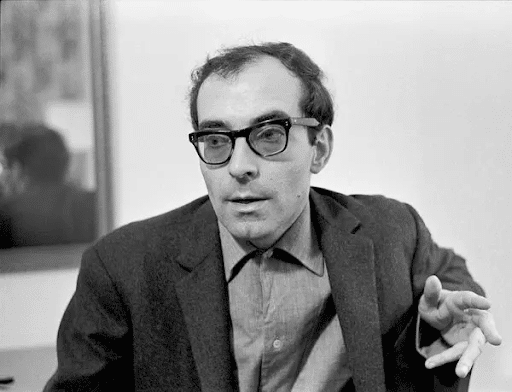
Jean-Luc Godard, one of the major icons of the French New Wave, once said that a film is essentially not just a collection of stories or images, but movement and transitions between shots. For Godard, the power of a film lies in elements often overlooked by casual viewers: cuts, pauses, rhythm, and how transitions build meaning.
From a creative marketing perspective, this statement holds a deep lesson. What Godard called “the invisible” also applies to the world of persuasion, branding, and visual communication. This article explores how Godard’s style teaches us the art of selling something intangible—emotions, ideas, even experiences—and how it can be applied not only by filmmakers but by anyone working in a creative field.
- Godard and the Cinema Revolution
Jean-Luc Godard emerged in the 1960s with a rebellious spirit against classical Hollywood cinema. He broke the rules, used sudden cuts, jump cuts, broke the fourth wall, and even reshaped narrative structures.
For Godard, a film did not have to follow a rigid linear pattern. He was more interested in exploring the feelings that arise from image-to-image transitions. This made his works feel both wild and poetic.
Behind all these “violations” lay one key skill: selling the invisible. Godard did not sell straightforward stories; he sold a cinematic experience full of surprises.
- What Does “Selling the Invisible” Mean?
In business, what is visible is the product. But often, what really drives purchasing decisions are invisible things: brand reputation, trust, communication style, or even emotional resonance.
The same applies to film. Audiences can see actors, sets, lighting, or costumes. But what truly engages them are the invisible elements: atmosphere, rhythm, emotional intensity, and the way a transition embeds meaning.
“Selling the invisible” means:
- Offering something that cannot be directly measured but can be felt.
- Making the audience believe in an experience, not just an object.
- Bringing value and meaning to the surface beyond what is visible.
- Transitions as a Tool of Persuasion
Godard understood that transitions between shots are the most subtle spaces for persuasion. Within a single cut, the audience’s emotions can shift dramatically.
Imagine a jump cut: the camera focuses on a man speaking, then suddenly cuts to a bustling street scene. What happens in the viewer’s mind? They try to connect two unrelated things, and that is where a new idea emerges.
This is the art of persuasion: letting the audience fill the gaps with their own imagination.
In marketing, this strategy resembles a story gap. Brands do not always provide all information at once. Instead, they create empty spaces that make consumers curious to complete the picture themselves.
- Selling the Invisible in Cinema
Here’s how Godard sells the invisible:
- Jump Cut: A sudden cut creates discomfort and freshness, keeping the audience alert and engaged.
- Breaking the Fourth Wall: Characters speak directly to the camera, shattering the film’s illusion. Viewers feel invited into the narrative world.
- Improvised Dialogue: Many Godard scenes feel natural because actors have freedom. Audiences experience spontaneity that cannot be reproduced.
- Non-linear Rhythm: Godard’s films often jump around, yet this creates a strong emotional atmosphere.
All of these are ways of selling the intangible—something that cannot be directly grasped but lingers in the viewer’s experience.
- Applying Godard’s Concept in Modern Creative Work
- Branding: A logo is just a visual form. What is really sold is the trust it evokes. Like Godard’s transitions, brand identity should convey meaning between lines, colors, and shapes.
- Digital Storytelling: On social media, audiences do not always read long content. They engage with short clips—15-second videos, brief captions, or fast visual transitions—just like Godard’s jump cuts.
- Music Videos and Ads: Many modern ads rely more on atmosphere than linear storytelling. They do not explain the product in detail but sell a lifestyle, mood, or feeling.
- Challenges of Selling the Invisible
Selling something intangible is not easy. Three major challenges are:
- Making the audience believe in something they cannot touch.
- Measuring the impact of something abstract.
- Maintaining consistency: keeping the invisible present in every aspect of communication.
Godard faced these challenges in cinema. Creators and marketers in today’s digital era face the same.
- Key Lessons from Godard’s Style
- Courage to Break Rules: Innovation comes from disobedience to old patterns.
- Value Empty Space: Do not always explain everything; leave room for the audience to imagine.
- Atmosphere Over Linear Narrative: Viewers may forget story details, but they will remember how the film made them feel.
- Persuasion Works Between Transitions: Like human relationships, the strongest impact is often not in words, but in the pauses between them.
Conclusion
Godard teaches us that film is not just about images, actors, or dialogue. Film is the art of building meaning through movement and shot transitions. Likewise, success in marketing and branding depends not only on what is visible but also on how we sell invisible experiences.
If you are a creator, business, or brand seeking to learn how to sell the invisible through visuals, storytelling, and strong atmosphere, collaborating with a team that understands this essence is the best step. Heroes Pictures is here to help you realize a vision that can not only be seen but also felt.
📱 +62 812 9860 4516
📧 admin@heroespictures.id